One of my kids had to do a little speech today on the meaning of his name. When I look back on how we chose his name, it all seems unplanned to me. We went to the hospital with three boys names (Jasper, Jackson or Finn) and two girls names (Zoe or Julia) picked out. He came home with a completely different name with meanings that fits him so well now that we really know him: willful, desiring, protective, sheilding, taking someone else's place.
It got me thinking about my given name Melanie Susan Tyler - meaning black lily tile maker. Hmmm. So fitting for me these days. Certainly my parents didn't plan that. I remember when I learned that my first name meant black. It never made much sense to me. Now that I think about it at this point in my life, I realize I've made tiles in many different colors, but I'm always drawn back to black as the base color for me to carve into. Perhaps this urge has been with me since I was born.
What does your name mean? Does it "fit"?
Friday, September 21, 2012
Monday, September 10, 2012
Firing - the magic of ceramics - a potter's "test kitchen"
I have a SKUTT 1227 Kiln. It's an electric Cone 8 kiln with an electronic kiln controller that I typically fire to Cone 6.
In the past, I always have done test firings to reach Cone 6 at medium speed with no hold time. After attending NCECA last spring in Seattle, I was inspired to finally start experimenting with my kiln's Ramp/Hold features. I saw some amazing before and after results with glazes when controlled heating and cooling was used.
I read an interesting article called "Glaze is Not a Rock by Carol Marians". Read it for yourself to better understand what is happening to the molecules on the glazes as they are being heated up and then cooled. She uses a great girls on a train analogy that I found helpful.
Marians wrote another great article about cooling in Ceramic Arts Daily called "The Many Faces of Iron: An Exploration in Cooling". It has some great images that show how varied a glaze can appear when cooled at different rates.
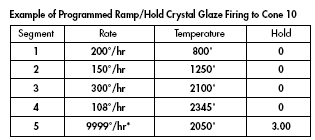
The kiln's Ramp/Hold mode allows people to design their own firing programs in different segments. Each segment can include temperature rate, end temperature and holding time.
I'm still working on testing out my glaze combinations with different Ramp and Hold schedules. Every potter's schedules will vary depending on the clay body and glazes they are using.
Glaze firing clay is kind of like baking a cake. When you make a cake, you can bake it at 450 for 10 minutes or 350 for 22 mintues. In both cases, the cake will be "done", but the results will be very different. It's the same with glazes. Using different firing schedules can product incredibly varied results in the glaze finishes.
For me, this is the fun part. It's kind of like working in a test kitchen with different recipes. Only you can't eat the results - perhaps just eat off of them.
In the past, I always have done test firings to reach Cone 6 at medium speed with no hold time. After attending NCECA last spring in Seattle, I was inspired to finally start experimenting with my kiln's Ramp/Hold features. I saw some amazing before and after results with glazes when controlled heating and cooling was used.
I read an interesting article called "Glaze is Not a Rock by Carol Marians". Read it for yourself to better understand what is happening to the molecules on the glazes as they are being heated up and then cooled. She uses a great girls on a train analogy that I found helpful.
Marians wrote another great article about cooling in Ceramic Arts Daily called "The Many Faces of Iron: An Exploration in Cooling". It has some great images that show how varied a glaze can appear when cooled at different rates.
The kiln's Ramp/Hold mode allows people to design their own firing programs in different segments. Each segment can include temperature rate, end temperature and holding time.
I'm still working on testing out my glaze combinations with different Ramp and Hold schedules. Every potter's schedules will vary depending on the clay body and glazes they are using.
Glaze firing clay is kind of like baking a cake. When you make a cake, you can bake it at 450 for 10 minutes or 350 for 22 mintues. In both cases, the cake will be "done", but the results will be very different. It's the same with glazes. Using different firing schedules can product incredibly varied results in the glaze finishes.
For me, this is the fun part. It's kind of like working in a test kitchen with different recipes. Only you can't eat the results - perhaps just eat off of them.

Monday, September 3, 2012
Shrinkage
I'm talking about clay shrinkage, not the George Costanza "I was in the pool" type of shrinkage. (One of those words that will likely live in pop culture for the generation of people who tuned in to Seinfeld every week.)
In fact, the shrinkage that occurs with clay firing happens because of extreme heat, not cold. When clay is fired, the moisture is removed from the clay making it hard. The higher the temperature the clay is fired to, the stronger it becomes. Each piece is fired twice, one time for bisquing and then again after the glaze is applied. Most of my finished pieces are fired to Cone 6 on the Pyrometric Cone Scale which is about 2232* F. Yes, that's HOT!
Every clay body has a different shrink rate. Most of the clay bodies I work with have about a 12% shrink rate. While that might not sound like a lot, it sometimes is surprising how much it really is once a piece is finished.
I use a product called a "shrink rule" to help me cope with clay shrinkage. Often customers want a specifically sized finished piece. The shrink ruler helps eliminate a lot of the guess work that would normally occur when trying to estimate the size of a finished piece after shrinkage (assuming you know the shrink rate of the clay body you are using).
Next time you see a really large piece of pottery - think about how much bigger it was when it was created. It'll seem even more impressive!
In fact, the shrinkage that occurs with clay firing happens because of extreme heat, not cold. When clay is fired, the moisture is removed from the clay making it hard. The higher the temperature the clay is fired to, the stronger it becomes. Each piece is fired twice, one time for bisquing and then again after the glaze is applied. Most of my finished pieces are fired to Cone 6 on the Pyrometric Cone Scale which is about 2232* F. Yes, that's HOT!
Every clay body has a different shrink rate. Most of the clay bodies I work with have about a 12% shrink rate. While that might not sound like a lot, it sometimes is surprising how much it really is once a piece is finished.
I use a product called a "shrink rule" to help me cope with clay shrinkage. Often customers want a specifically sized finished piece. The shrink ruler helps eliminate a lot of the guess work that would normally occur when trying to estimate the size of a finished piece after shrinkage (assuming you know the shrink rate of the clay body you are using).
![]() |
| Here is a picture of a shrink ruler next to a standard 12 inch ruler Different sides of the ruler show different shrink rates. The shrink ruler is one of my most used tools in my studio. |
Subscribe to:
Posts (Atom)