

Showing posts with label skutt 1227 kiln. Show all posts
Showing posts with label skutt 1227 kiln. Show all posts
Monday, November 11, 2013
Kiln gods

Monday, September 10, 2012
Firing - the magic of ceramics - a potter's "test kitchen"
I have a SKUTT 1227 Kiln. It's an electric Cone 8 kiln with an electronic kiln controller that I typically fire to Cone 6.
In the past, I always have done test firings to reach Cone 6 at medium speed with no hold time. After attending NCECA last spring in Seattle, I was inspired to finally start experimenting with my kiln's Ramp/Hold features. I saw some amazing before and after results with glazes when controlled heating and cooling was used.
I read an interesting article called "Glaze is Not a Rock by Carol Marians". Read it for yourself to better understand what is happening to the molecules on the glazes as they are being heated up and then cooled. She uses a great girls on a train analogy that I found helpful.
Marians wrote another great article about cooling in Ceramic Arts Daily called "The Many Faces of Iron: An Exploration in Cooling". It has some great images that show how varied a glaze can appear when cooled at different rates.
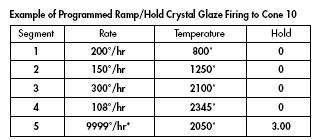
The kiln's Ramp/Hold mode allows people to design their own firing programs in different segments. Each segment can include temperature rate, end temperature and holding time.
I'm still working on testing out my glaze combinations with different Ramp and Hold schedules. Every potter's schedules will vary depending on the clay body and glazes they are using.
Glaze firing clay is kind of like baking a cake. When you make a cake, you can bake it at 450 for 10 minutes or 350 for 22 mintues. In both cases, the cake will be "done", but the results will be very different. It's the same with glazes. Using different firing schedules can product incredibly varied results in the glaze finishes.
For me, this is the fun part. It's kind of like working in a test kitchen with different recipes. Only you can't eat the results - perhaps just eat off of them.
In the past, I always have done test firings to reach Cone 6 at medium speed with no hold time. After attending NCECA last spring in Seattle, I was inspired to finally start experimenting with my kiln's Ramp/Hold features. I saw some amazing before and after results with glazes when controlled heating and cooling was used.
I read an interesting article called "Glaze is Not a Rock by Carol Marians". Read it for yourself to better understand what is happening to the molecules on the glazes as they are being heated up and then cooled. She uses a great girls on a train analogy that I found helpful.
Marians wrote another great article about cooling in Ceramic Arts Daily called "The Many Faces of Iron: An Exploration in Cooling". It has some great images that show how varied a glaze can appear when cooled at different rates.
The kiln's Ramp/Hold mode allows people to design their own firing programs in different segments. Each segment can include temperature rate, end temperature and holding time.
I'm still working on testing out my glaze combinations with different Ramp and Hold schedules. Every potter's schedules will vary depending on the clay body and glazes they are using.
Glaze firing clay is kind of like baking a cake. When you make a cake, you can bake it at 450 for 10 minutes or 350 for 22 mintues. In both cases, the cake will be "done", but the results will be very different. It's the same with glazes. Using different firing schedules can product incredibly varied results in the glaze finishes.
For me, this is the fun part. It's kind of like working in a test kitchen with different recipes. Only you can't eat the results - perhaps just eat off of them.
 |
Example of a Controlled Cooling Schedule.
*Note that 9999 on a Skutt Kiln program represents the default for the maximum heating or cooling rate. This will vary depending on the kiln, how packed the load is, the air circulation and the room temperature.
I find that in the dead of winter or peak heat of the summer heating and cooling rates can really vary for me, as my studio space doesn't have a heating or cooling system.
|
Subscribe to:
Posts (Atom)